Episode 59

full
Published on:

21st May 2026

The Traps Never Leave (And Why Patches Make It Worse)

The four traps—Control, Variability, Memory, Visibility—never go away. You can minimize them. You can manage them. But you can never fully eliminate them. They're baked into every process.

When business owners see a trap, their instinct is to patch it. Add a checklist. Add an approval. Add a reminder. Add a review. But patches don't fix traps. They create operational debt.

The bathroom checklist example: A checklist that requires someone to remember to use it is a patch on the Memory Trap... that itself has a Memory Trap. The checklist didn't solve the problem. It just moved the problem.

Patches are workarounds disguised as systems.

  • Memory Trap → checklist, reminder, calendar invite
  • Control Trap → approval step, sign-off
  • Variability Trap → review, quality check
  • Visibility Trap → report, dashboard

Operational debt is like financial debt but not on your balance sheet. Research shows it can cost up to 25% of your revenue. Every checklist, approval, review, and dashboard adds weight.

Operational debt creates three types of drag:

  1. Speed (every patch slows things down)
  2. Confusion (new employees can't figure out the buried system)
  3. Brittleness (patches don't adapt; changes break them)

The alternative isn't more patches. It's seeing the traps for what they are.

Patching is reactive—you see a problem, you slap something on it. Managing is intentional—you ask: Can I remove this step? Can I redesign so the trap doesn't exist? Can I automate so humans don't have to remember?

"Patches add to the process. Managing subtracts from it."

"Remove before you automate. Simplify before you systemize."

If you automate a trap without fixing it first, the trap gets amplified. Now you have faster, more consistent chaos.

The key insight: Seeing the traps is the advantage. Once you see them, you can't unsee them. You're not seeking perfection. You're seeking awareness.

Your action: Find one patch in your business. A checklist nobody uses. An approval that's rubber-stamped. A report nobody reads. Ask: Is this solving the problem or just moving it?

Next episode: How to audit a process before you automate—Clarify the Flow.

Got a business question? Ask Scott here: scotttodd.net/ask
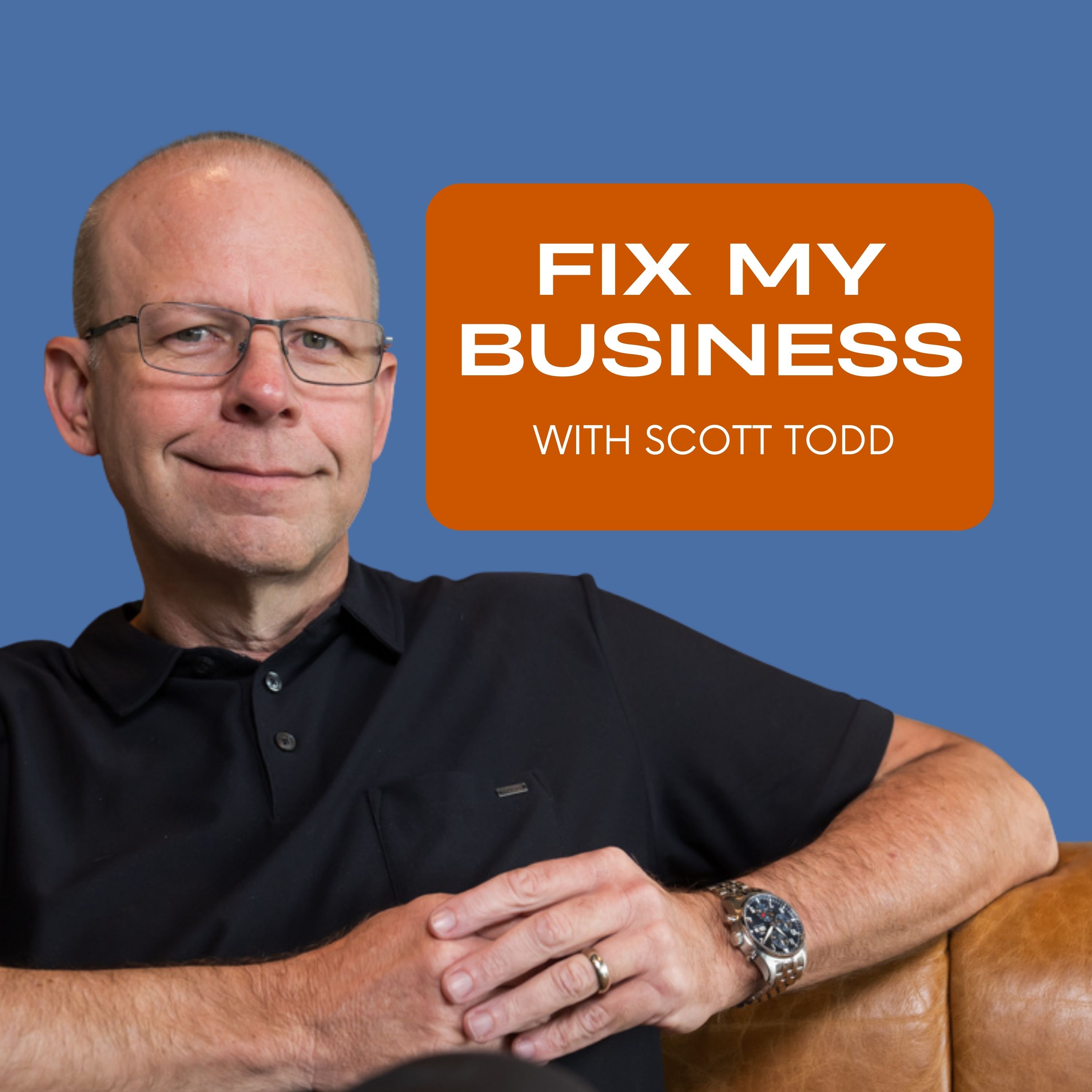
Show artwork for Fix My Business

About the Podcast

Fix My Business
Business problems feel overwhelming because you're trying to fix everything at once. Fix My Business cuts through the noise by answering one real question per episode—giving you clarity, a clear diagnosis, and one action you can take this week.

Hosted by author and entrepreneur Scott Todd, this show isn't about theory or motivation. It's about solving the actual problems that keep business owners stuck: revenue up but profit down, marketing that doesn't work, chaos that won't stop, and the constant feeling that you're one step behind.

Scott left a Fortune 300 VP role to build multiple seven-figure companies. His book, Fix This Next for Real Estate Investors (releasing January 2026), introduced the Investor Priority Pyramid (IPP)—a framework for knowing exactly what to fix next when everything feels urgent. Now, he's bringing that same diagnostic approach to business owners across every industry.

What makes this show different:
Every episode starts with a real question from a real business owner. Scott diagnoses the actual problem (not the surface symptom), explains why it's happening, and gives you one clear move to make progress this week. No 10-step plans. No vague advice. Just: here's what's wrong, here's why, here's what to do.

You'll learn how to:
-Identify the real problem hiding underneath the chaos
-Use frameworks like the Investor Priority Pyramid (IPP), the Survival Trap, and the Scaling Trap to understand where you're stuck
-Fix margin erosion, cash flow issues, and operational breakdowns
-Build systems that let your business run without running you
-Move from grinding for revenue to printing profit

Scott's background spans over three decades in corporate leadership (Fortune 300 executive in IT, operations, and finance) and entrepreneurship (Landmodo, Passion IT Group, and other ventures). He thinks like an operator, not a guru. His frameworks—IPP, the Freedom Number Formula, ACRE, and the DREAMS Framework—translate complex strategy into simple, repeatable actions.

This show is for:
-Business owners working harder but taking home less
-Entrepreneurs stuck in the Survival Trap (revenue grows, chaos grows faster)
-Operators who want clarity on what to fix first when everything feels broken
-Anyone tired of motivational advice who wants tactical, diagnostic problem-solving

Each episode includes:
-The Question: A real problem from a real business owner
-The Diagnosis: What's actually wrong (the thing you can't see on your own)
-The Action: One move you can make this week to fix it

If you're ready to stop guessing and start fixing, this is your show.

Scott Todd is an entrepreneur, real estate investor, and author of Fix This Next for Real Estate Investors (January 2026). He's the creator of the Investor Priority Pyramid™ and the Freedom Number™ framework. Through his companies, writing, and this podcast, he helps business owners escape overwhelm and build businesses that operate without consuming their lives. Learn more at ScottTodd.net.

About your host

Profile picture for Scott Todd

Scott Todd